An inherited house can't be sold the day you decide to. First you have to open three locks that, on their own, aren't difficult — but together they leave families stuck for months.
In short
To sell, you must accept the inheritance, settle Inheritance Tax and the municipal capital-gains tax (plusvalía), and register the property in the heirs' names at the Land Registry. Only then can it be sold to a third party. If there are several of you — co-ownership — everyone must sign, or the ownership must be resolved first.
First comes a phone call. Then, a long silence.
And a house still furnished, keys in the door, but empty.
You want to sell it and move on. But you can't yet.
Why you can't sell on day one
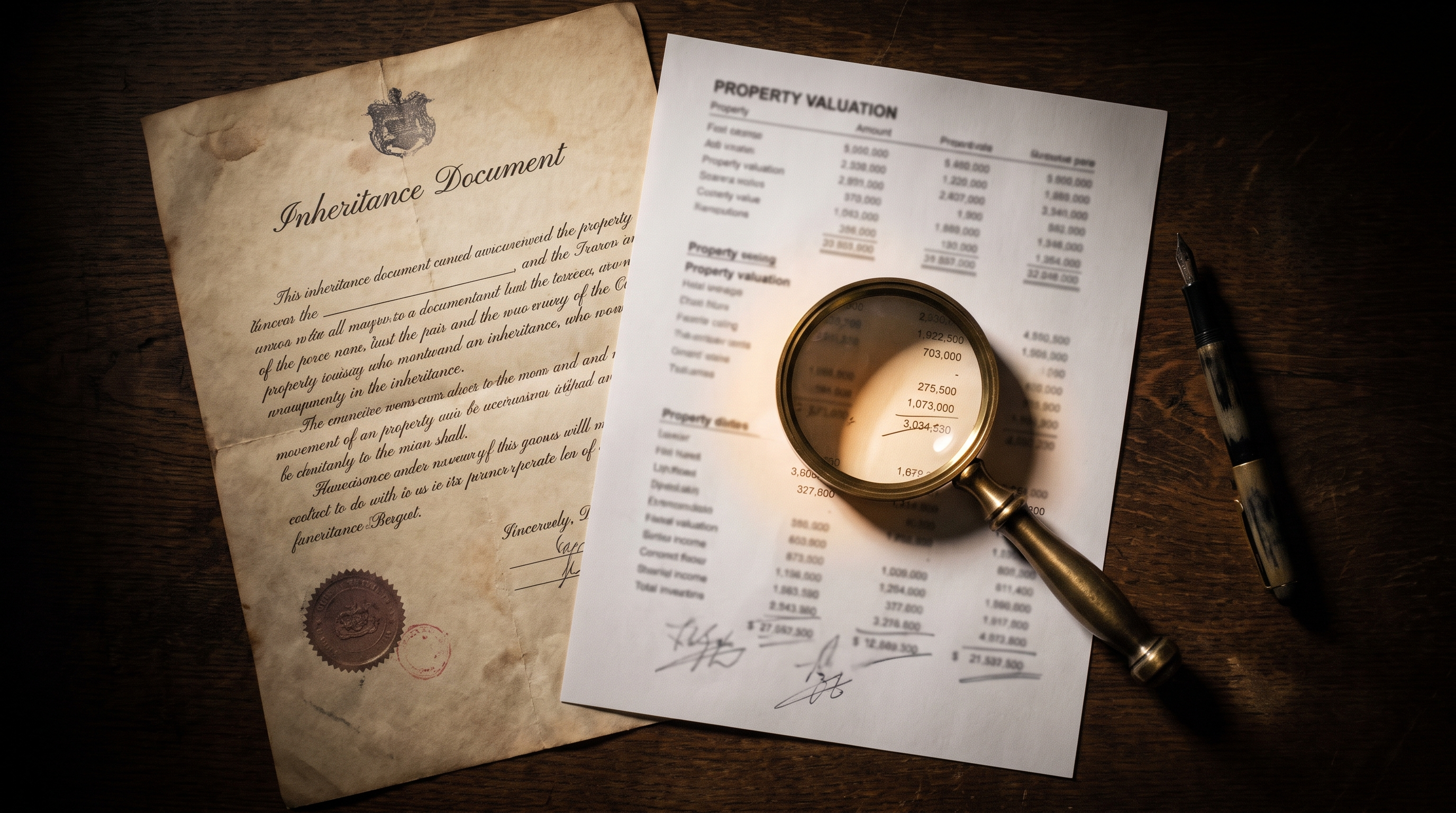
When someone passes away, their home does not automatically pass into your name. For a while the house is, legally, in no-man's-land: it belongs to "the estate", not to you. And you can't sell something that isn't yet registered in your name at the Land Registry.
Turning that house into something you can sell means opening, in order, three locks. None is especially complicated. The problem is that most families don't know they exist until they've already been stuck for months.
What must be opened before you can sell
00 / 03
Accept the inheritance before a notary
Settle Inheritance Tax and the municipal plusvalía
Register the property in your name at the Land Registry
How each lock opens
Lock 1 · Accept the inheritance
You sign the deed of acceptance and allocation before a notary. For that you need the death certificate, the certificate of last wishes and the will. If there is no will, a declaration of heirs is processed first, designating who inherits under the law. This is the step that turns the family into the legal owner.
Lock 2 · Pay the taxes
Inheritance Tax must be settled within six months of the death — extendable by another six if requested in time. In the Canary Islands there are very significant reliefs for a spouse, children and ascendants, which in many cases cut the bill dramatically; always review them with an adviser, as they depend on the degree of kinship and the value.
You must also pay the municipal capital-gains tax (plusvalía, IIVTNU) on the inherited transfer, to the relevant town hall. These are two separate taxes, each with its own deadline, and missing them carries surcharges.
Lock 3 · Register at the Land Registry
With the deed of acceptance and the taxes settled, the property is registered in the heirs' names at the Land Registry. This is the step almost everyone forgets and the one that truly opens the door: without the house registered in your name, no buyer can sign with you.
When the house belongs to several people, selling needs every signature.
There's a figure almost nobody looks at: the value you declare when you accept the inheritance.
Sell close to that value and the capital gain on your income tax return will be minimal.
Declare it too low and the tax will reach you years later, when you sell.
How much tax will I pay when I sell?
When you sell, any capital gain on your income tax (IRPF) is calculated on the difference between the value declared in the inheritance and the sale price. If you sell close to the inherited value, the gain — and therefore the tax — is low. That's why the value declared at acceptance is not a mere formality: it's a decision that follows you all the way to signing day.
Declaring it artificially low to pay less Inheritance Tax can prove costly later, when that difference reappears as a gain on the sale. The right balance is studied case by case, with an objective valuation of the property from the outset.
And if there are several of you and you can't agree?
It's the most common — and most delicate — situation. When several people inherit, the house is held in co-ownership (proindiviso): you each own an undivided share, but none of you owns a specific room. And a single missing signature blocks the entire sale. The good news is that it almost never has to reach court. There are three routes.
Route · 01
Sell together
All the heirs sign the sale and the price is shared out according to each one's share. It's the simplest route when there is agreement: a single transaction, a single buyer, and everyone receives their part at the notary.
Route · 02
Dissolving the co-ownership
One of the heirs keeps the house and buys out the others' shares at market price. The family stops sharing the property, the one who stays pays the others, and it usually carries tax advantages over an ordinary sale.
Route · 03
Neutral mediation
When the conflict is more personal than financial, an intermediary who takes no side puts the figures on the table and proposes a way out. It's almost always the piece that unblocks the agreement without breaking the family apart.
Real case · anonymised
Three siblings · Ciudad Jardín
They inherited a flat. Two wanted to sell, one didn't. They'd been stuck for almost a year, not speaking, while the empty house lost value every month.
We ran an objective valuation, put the figures on the table and proposed dissolving the co-ownership: the sibling who wanted to keep it bought out the shares of the other two at market price.
No one had to go to court. The family got their relationship back, and each received what was due to them without leaving the inheritance frozen for another year.
What you should have ready
Gather from the outset, and digitally: the death certificate, the certificate of last wishes, the will or declaration of heirs, the deed of acceptance and allocation, proof that Inheritance Tax and the municipal plusvalía have been paid, and an up-to-date nota simple (Land Registry extract) showing the property is already registered in your names. With that, the legal side is resolved and the sale can truly begin.
And one thing that saves months: prepare the valuation and look for a buyer in parallel while the paperwork advances. There's no need to wait until everything is closed to start moving.
Frequently asked questions
How long until an inherited house can be sold?
It can be sold as soon as the property is registered in the heirs' names at the Land Registry. With the paperwork complete, that usually takes a few weeks; after that, the sale follows the normal process of any home.
Do you have to pay taxes before selling?
Yes: Inheritance Tax and the municipal capital-gains tax (plusvalía) on the inherited transfer. When you sell, there may also be a capital gain on your income tax, calculated on the difference between the value declared in the inheritance and the sale price.
What if one heir doesn't want to sell?
There are routes without going to court: dissolving the co-ownership (one heir buys out the others' shares), a joint sale with the price shared out, or mediation by a neutral intermediary to unblock the agreement.
Can I sell if I haven't accepted the inheritance yet?
Not until it's accepted and registered in your name. But you can prepare the valuation, the paperwork and the search for a buyer in parallel, so you don't lose time while the formalities advance.
Who benefits from the Canary Islands Inheritance Tax reliefs?
They usually benefit close relatives — a spouse, children and ascendants — significantly. The extent depends on the degree of kinship and the value inherited, and the rules can change, so always review it with a tax adviser before settling.
Do you have a stalled inheritance?
Tell us your situation. We'll study it with no obligation and tell you the fastest route — and, if there are several of you, how to unblock it without conflict.
This content is for information only and does not constitute tax, legal or financial advice. Deadlines, taxes and reliefs depend on each case and on the rules in force at the time, which may vary. Consult a qualified professional before making decisions.
Wally NeveurFounder and estate agent · NEVEUR Real Estate, Las Palmas de Gran Canaria
Sources
Government of the Canary Islands — Inheritance and Gift Tax
Las Palmas de Gran Canaria City Council — municipal capital-gains tax (IIVTNU)
Spanish Tax Agency — capital gains on income tax (IRPF)
Land Registry — Association of Registrars of Spain